Showing posts with label aleksander sokurov. Show all posts

Tuesday, October 2, 2012

SOKUROV'S NEW TAKE ON 'FAUST'


I AM immediately drawn to the name ‘Sokurov’ as I glance over the Melbourne International Film Festival guide in The Age. It all began at an earlier MIFF occasion- ‘Mother and Son’- going by, admittedly, a heartfelt recommendation by Nick Cave that was originally published in ‘The Independent on Sunday’:
 
'A FRIEND of mine invited me to attend an advance screen of a Russian film in Soho. I asked him what it was like and he said, "Well, nothing really happens and then someone dies. Come along. You'll love it." My friend was releasing the film in this country, so I felt obliged. Sitting through a Russian film is the kind of thing friends do for each other.

I arrived late and made my way to the front row just as the opening credits were ending. Ten minutes in, I started quietly crying and continued to do so for the 73-minute duration of the film. Now, I've cried in films before but I can't remember crying quite so hard, without pause, all the way through. When the film ended and the lights came on, a red-eyed woman sitting behind me pushed a Kleenex in my direction and asked me if I would write something about it for one of the newspapers.
The film is called Mother and Son, and is directed by Aleksandr Sokurov. It explores the final day in the life of a dying mother (Gudrun Geyer) and her adult son (Alexei Anaishnov). It is morning. The mother wants the son to take her for a "walk", which involves carrying her through a series of dreamlike landscapes, whereupon he returns to their bare, isolated home, feeds her, and puts her to bed. The son then leaves the house to walk on his own and returns to find that she has died. All this takes 76 minutes. But what we witness in that time is a thing of such beauty, such sadness, that to cry, for me, was the only adequate response.It was a profound experience.'


 Such a simple story of a love a son has for his dying mother. He carries her across stunning landscapes that are filmed with some sort of a distorted – known as anamorphic- lens, inspired by the craftsmanship of Caspar David Friedrich. She is lovingly cradled in his arms like the Pieta, and their image appears at the bottom of the screen, at the bottom of a path that reaches upwards along a kind of valley. It takes some time for the distant figures to reach the top of the screen, hence the top of the mountain. It reminds me of Van Gogh’s appreciation of the Christina Rossetti poem:

‘Does the road go uphill all the way?’

‘Yes, to the very end.’

‘And does the journey take all day?’

‘From morn to night, my friend.’


Thankfully, Sokurov has all the patience in the world as we celebrate the moving and beautiful portrait of this son’s love for his mother. There is very little need for dialogue. Dialogue would spoil the mood. There are insects, however, and the final inevitable release. The emotions for the mother are palpable.  It is no less tense, but far less complex, than Paul Morel’s love for Gertrude Morel in Lawrence’s ‘Sons and Lovers.’ Like Gertrude Morel, this Russian man’s mother dies too, but much more quietly and peacefully, accepting the inevitability of death. Her son has taken his mother on her final journey, so there must be a sense of relief for him, too.

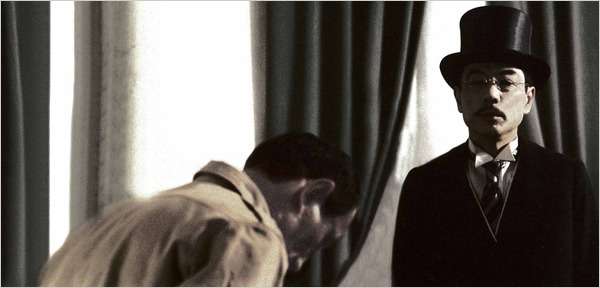
Another MIFF brought us “The Sun’, about Emperor Hirohito, and the enormous sense of expectation on his shoulders as Japan’s role in the Second World War becomes increasingly complex and the war is ending. Hirohito is in a bunker underneath Tokyo. He is fascinated with marine life and in an extraordinary sequence marvels over a specimen crab. Equally interesting is his vision of flying fish as airplanes in the sky.  It is a very personal piece which examines Hirohito’s conscience and portrays him as a man who, although at odds temperamentally with General Macarthur, also in the film, is able to share dinner and a cigar with him. Hirohito seems timid and child-like, against the brash American. The American press corps take delight in photographing this strange, elusive man, which is the funniest moment in the film.


I saw ‘Russian Ark’ at the old Lumiere cinema in Exhibition Street. A stunning technical achievement, the camera and the film’s narrators wander through a multitude of rooms inside the Winter Place, recreating a tapestry of historical events, all done without any digital editing, in a single sequence. The scene in which the ghostly figure of the eccentric narrator pauses in front of Rembrandt’s ‘Return of the Prodigal Son’ is a personal favourite. Each room seems to represent a different historical period, including the time of Peter the Great, Catherine the Great and the frightening world of Josef Stalin. The location is beautiful, as are the costumes and paintings. A long sequence of an orchestra being filmed is slow and seductive, and the large number of inhabitants inside the Winter Palace, drift out the exit and into the cold air during the closure of the film.


‘Father and Son’ was played as a one off at the Nova in Carlton, as part of a Russian Film Festival called, I think, ‘Russian Resurrection.’  The beauty and honesty and tenderness of a parent and a sibling is quite different here. I would love to see the film again. I remember a lot of shots on a rooftop somewhere in Russia, and some stained glass. Like some of his other films, there isn’t a lot of action. It is mostly meditative. The experience was almost as equally moving as the tenderness in ‘Mother and Son.’ This time it is like the touch between father and son in Rembrandt’s ‘The Return of the Prodigal Son’, except there is a homo-erotic element which I find fascinating. Their embraces are vigorous and warm and sometimes vaguely sexual.


‘Which takes me to ‘Faust’, which is based on Goethe’s version, not the Marlowe that I taught at Newent Community College in Gloucestershire, which is the one I am familiar with. The film went for over two hours, but it went by very quickly, and tired as I was, I concentrated on every frame, marvelling at the lighting, the depiction of a previous time, the ancient villages and rugged landscapes. Faust is impoverished and unfulfilled and desperate to know the secrets of the soul. He meets a bizarre Mephistopholean figure, who has a body that is more bestial than human, with a penis attached from behind rather than at front. Faust makes his pact, written in his blood, and finds himself unwittingly wearing armour in the loneliest and most desolate landscape imaginable. This, it seems, is his Hell- there is no way out and no food or water, not exactly the gates of Hell opening, as in the Marlowe, but devastating for him nevertheless.  I was hoping to see that horrific, doomed,  fiery opening. Faust gets his woman, the Gretchen, in this film called Margarete. She is pale and innocent looking, porcelain and quite beautiful, and rural looking. Faust is obviously desperate for his moment in time with her. When it comes it is surprisingly understated, rather than being lustful or overtly sexual. Faust does pore over her naked body but it is sensitively done. Sokurov uses the most intense close-ups I have ever seen, and her pale face and reddish hair lights up the screen in this incredible yellow glow. All else is dark. The heads of other members of the audience are lit up as well. Sokurov revisits the anamorphic lens, reminiscent of ‘Mother and Son’ again, but this time inconsistently, as if he wants to try it for a certain effect in some shots only. I read somewhere that the painterly influence is someone other than Casper David Friedrich this time- someone I don’t know called David Teniers, a Flemish painter, and a landscape painter from the same period known as Herri met de Bles. It is the latter that is the more obvious-  I have looked at these pictures and I can see the striking resemblance.


The influence of a painter on a director and cinematographer is a fantastic thing. Ingmar Bergman admired Edvard Munch. I might be wrong, but I thought I could see Munch’s influence when I saw Bergman’s ‘Cries and Whispers.’ It is the stilted figures, the sisters, like in the sad, raw Munch pictures that show his grieving family.


The vision of Hell in Sokurov’s ‘Faust’ reminds me a lot of the vision Shakespeare created for the musing Claudio, facing execution,  in ‘Measure For Measure:

‘‘…to bathe in fiery floods, or to reside
In thrilling regions of thick-ribbed ice;
To be imprisoned in the viewless winds,
And blown with restless violence round about
The pendant world.’    


Friday, October 21, 2011

Saturday Reflections

I DREAD these public transport days on occasional weekends, especially train trips. I have never enjoyed train rides, probably connected to some hostile experiences at night on trains when I was younger. Sometimes it can be quite interesting though. Recently I had with me a National Geographic that contained an article about Amelia Earhart that was fascinating, and completely absorbed me until the train trundled slowly into Flinders St Station. I found out that she once travelled in her plane during a storm in which visibility was almost non-existent. It must have taken incredible bravery. They say she wasn’t the best pilot, male or female, of her time. But maybe she was the most ambitious and most courageous.


Last weekend the trip was in mid-afternoon from Preston to the city. I read the opening chapters of Alex Miller’s novel ‘Journey To The Stone Country.’ It didn’t grab me all that much but at least the time went quickly enough, so I must have been reasonably absorbed. I have read quite a bit of Alex Miller. I once wrote to him when he lived in Carlton about ‘Conditions of Faith’, his 2000 novel which is one of the best books I have ever read. I don’t like his other books nearly as much, although several are still very good. I am partly seduced by the Chartres Cathedral sections, where some of the significant action takes place. It is my favourite cathedral in the world. I love how you can see it on your approach for miles- how it totally dominates the town. How many lives have been directly influenced by it, whether involved in building it, maintaining it, working in it, or merely visiting it? There must be people who live in Chartres or its environs who visit it every day, and know all its intricacies. I find it fascinating that writers visit places (like film people looking for film locations) obsessively so they get to know the place intimately, in order to cover it faithfully in their stories. Much like Colm Toibin visited Henry James’ Lamb house many times for the relevant sections in The Master.’ Miller knew Chartres Cathedral well to write his novel.

The purpose of my trip to the city on Saturday was to meet Alex Miller, for the first time (oh, and to get him to sign some of my books). But first there was another train journey, this time to Glenferrie Station, to take me to a book launch at Hawthorn Readings, on Glenferrie Road. I didn’t feel like reading as much, so I observed this time. Sitting diagonally opposite me was a young couple, probably both about 18. They weren’t interesting per se, just really into each other and looking out the window, and pointing a lot as if it was the first time they had caught a train ride through the inner suburbs. He had pale skin and blonde hair, good looking in a classical Rupert Brooke private school style, a bit like the boy who is the object of interest in the film version of ‘Death In Venice.’ She was also blonde and tall and thin like Twiggy. Sitting opposite them was a middle aged man, probably mid-40’s, and he found them- her in particular- fascinating, to the point of rudeness. Even though he was sitting on the adjacent seat and in close proximity, he couldn’t tear his eyes away from the young couple. I couldn’t stop looking at him for his brazenness and yet they didn’t appear to even notice him.


The book launch of the new novel, Autumn Laing, was very late. I used my time though. Alex Miller was alone more or less (I was a half hour early), and he looked just like he does on book dust jackets. He wore a yellowish/ green suit jacket and looked preoccupied, maybe a bit overwhelmed. He might be one of those writers who don’t really like being the centre of attention. I walked over, very nervous myself, thinking of that beautiful, beautiful writing. Hand extended, I said ‘I have been wanting to meet you for a long time.’ I received a blank expression. I then went on to tell him I have taught ‘Conditions Of Faith’ before, and explained a couple of the passages that students have written closely on, like Emily returning to the ‘boat hire lady’ for the first time since she was a child. Again, a blank expression, when a smile was what I was expecting. Worse, I then nervously said ‘Conditions Of Faith’ was my favourite book of his. As I said earlier, it was written in 2000. So if you think about it, I am more or less saying that his eight or nine subsequent novels aren’t as good. Whoops. I didn’t get far with Alex Miller, but to his credit I was bumbling along not making a lot of sense, and he was understandably preoccupied.


There was a good hour after that before his publisher from Allen & Unwin had something to say. I was surrounded by strangers but I went up and introduced myself to some people. There were people who live in Miller’s home town of Castlemaine who were friendly. One man didn’t seem to know his novels terribly well, but he has a coffee with him every Saturday morning so I guess that’s pretty good. Another man I soon discovered is the Head of Art at La Trobe, Bendigo. He has written several books- ‘coffee table books’ he described them- and he talked about the writing process, and that writers don’t make much from their books- it’s the prize money that makes money for you, if you are good enough. Finally, and it was interesting, drifting from person to person- a man who is head of www.materialthinking.com , a website I have looked at since and can’t make a lot of sense of. I was curious to meet him because he and his partner had earlier given Alex Miller a huge hug.

But the highlight was Stephanie Miller. I introduced myself and told her how lucky she is to have a book like Conditions of Faith dedicated to her. He showed her bits and pieces as he was writing it. The beautiful Sophie, from the convent in Chantilly, evidently is based on his mother. Stephanie Miller was kind enough to write down their address in Castlemaine on a piece of paper.

I felt light headed as I caught a train back to the city around tea time. Some of the Caulfield Cup crowd was on the train. I watched a group of about five people, all around sixteen, seventeen, all dressed immaculately in suits with expensive looking jewellery. What caught my eye was a Japanese boy, with flashy, flamboyant dyed blonde hair, very sculptured, wearing black boots, black suit, very sophisticated for his age, he could have been in the new film ‘Norwegian Wood.’ His friends or associates were a bit like him as well, and the whole atmosphere of the train was a bit Caulfield Cup like, if you know what I mean.

I was walking around the city for a good hour, killing time until an engagement, walking past an amusement game shop, one of those dirty, tacky ones in Bourke Street, when lo and behold! There inside I discovered the Japanese group from on the train. And what’s more, they were really into some stupid, simulated game, stamping their feet and carrying on, and suddenly these sophisticates looked like a bunch of kids. Very amusing. I really read them wrong.

This was a great day for great conversations. I wandered into a nondescript DVD shop. There on display were all the best foreign language titles you could ever wish for. Lots of Bergman, Bertolucci, whoever it was that made ‘A Short Film About Killing’, etc and lots of Russian titles. I bought ‘Moloch’, directed by Sokurov. I got into conversation with the owner, and discovered that he too has seen almost every Bergman film. We agreed that ‘Scenes From A Marriage’ was close to our favourite.


So the night more or less finished with meeting a special friend I haven’t seen for ages. We drank outside The Elephant & Wheelbarrow. We go back quite a long way, but we only talked about current things, not much about the past. It was a lovely way to finish off a highly stimulating day.

The train ride home was dull, but safe. I continued reading Alex Miller, with fresh eyes because at last I have met him.

Following is a letter I wrote to Alex Miller back in 2005, which he kindly replied to.


December 31 2005


Dear Alex,


I felt inspired to write you a quick letter after spending the afternoon yesterday totally ignoring the cricket and reading ‘Prochownik’s Dream’ instead. I received the book as a present and took it with me to my sister-in-law’s house. We are minding their home whilst they are on holidays- she has air-conditioning. The house is around the corner from Bridge Road- this unforeseen connection with your novel enhanced my enjoyment of it.


I teach Literature at a school near Melbourne. During the past three years I have taught Conditions of Faith as one of the texts- a hugely enjoyable experience for me and my students. I am especially drawn towards it because Chartres Cathedral is one of my favourite places in the world- I love making connections between novels and places I have seen. Another example of its type is Lincoln Cathedral and its importance in The Rainbow. We have had a lovely time with Conditions of Faith as I have said, my students amused by my attraction towards Sophie. I think that some of the best passages are those involving Sophie and Emily.


Now that my wife J is pregnant, this time the novel held more meaning for me, and I am pleased to say that J is far more sensible than Emily in these matters. And as far as I know there wasn’t any clandestine meeting with strangers in her case- perhaps I will learn otherwise when the baby is born in three weeks time!


Getting back to your newest novel, this held resonance for me as well. I mentioned that I read it here in Richmond, which is where I spend a lot of time because of family connections. There were a lot of references to Mount Macedon. This is where a close friend lived until they sold their house near Waterfalls Rd in 1998, and it is where the two of us first met in 1993, at The Mountain Inn. I also enjoyed the reference to Beverley Farmer. Do you know her? She is someone that I exchange emails with- we are both members of the D H Lawrence Society, and we share an interest in lots of writers and artists.


The two novels I have read of yours are both full of ideas, and both have left me asking lots of questions about life and of myself. I found it interesting that you have created two people who are so alike in lots of ways- I am referring here to Emily and Toni. They are both so driven by what interests them- research and painting- and their intensity means that there is a huge impact on their personal lives. Both Emily and Toni find it virtually impossible to chase their dream and be able to include and sustain their partner and their daughter. In both cases it seems their work and their dream are ultimately too important for them to compromise, even at the expense of their own family. It makes me think of all those writers and musicians and artists out there who don’t forsake their relationships, thereby compromising, and becoming mediocre as a result. Living alone and apart, like Vincent Van Gogh, means you can thrive in your work because your work has priority, and yet you miss out on other good things so much, too, as he acknowledges so much.


A great contrast in your two novels lies in the characters of Georges and Teresa. Both these people are frustrated and are scared to death that their respective marriage is going to collapse. They make little concessions of their own to try and ride out the time during their partner’s obsession. The way in which they deal with the ultimate collapse is so different. I am glad that you didn’t make Teresa passive, like Georges. It gave me an opportunity to see what you are like when you are writing about someone with anger and violence in them, and it was so melodramatic compared to Georges’ quiet acceptance of discovering that Emily is leaving him around the time of the jazz concert.


Well I am sweltering in the backyard in my little study/ bungalow surrounded by all my books and pictures and posters. I will finish now and say that I hope this letter has somehow reached you. Prochownik’s Dream will stay with me for a long time like Conditions of Faith has. I can see that Toni, like Emily, has great ambition and hope for his work, and that it goes beyond what his friend, Andy wants, and that is making lots of money.


I will finish with a couple of little questions-


a) Where can I get a book or a poster of Chartres Cathedral for my study?

b) Does The Red Hat really exist?

c) Have you spent time yourself in Mt Macedon and is ‘Plovers’ there?


If you get time to respond I would love to hear from you.


Yours, Darren Harrison